
Key points
- Overtime is paid at at least twice the normal rate of wages.
- Overtime work is consent based.
- Working hours are capped at 8 to 12 hours a day and 48 hours a week, depending on the rules for your kind of work.
- Overtime pay = hourly rate × 2 × overtime hours.
Key facts (as of 16 November 2026)
- The four Labour Codes apply from 21 November 2025 (PIB).
- Overtime beyond the prescribed hours is consent based and paid at least double the normal wage rate (PIB).
- Working hours: 8 to 12 hours a day, 48 hours a week (PIB).
- The divisor used for the hourly rate depends on the rules for your establishment; we found no single national divisor.
Updated 16 November 2026.
What is the overtime rate in India?
Under the Labour Codes, overtime is paid at not less than twice the normal rate of wages. An employee whose normal rate is ₹100 an hour gets at least ₹200 for each overtime hour. Overtime is work beyond the prescribed daily or weekly hours, and it needs the worker's consent.
The Codes have applied since 21 November 2025. They replaced the older Acts, such as the Factories Act, that set overtime rules before. The rules under the Codes are being framed in stages, so also check the central or state rules for your establishment.
How do you calculate overtime pay?
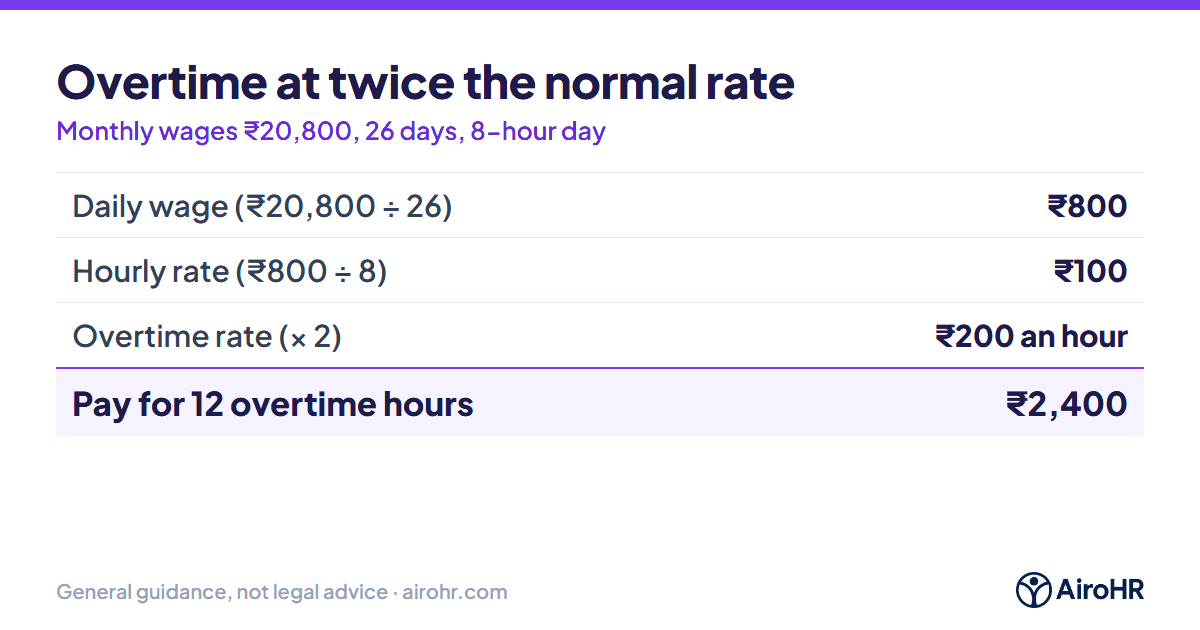
Divide the monthly wages by the working days in the month and by the normal hours in a day to get the hourly rate. Multiply that rate by two, then by the overtime hours worked. For ₹20,800 a month, 26 days and 8 hours: ₹100 an hour, ₹200 for overtime, ₹2,400 for 12 hours.
- Hourly rate = monthly wages ÷ working days ÷ normal hours a day.
- Overtime rate = hourly rate × 2 (or more, if your policy pays more).
- Overtime pay = overtime rate × overtime hours in the month.
Worked example: ₹20,800 a month, 12 overtime hours
An employee's monthly wages are ₹20,800. The establishment uses 26 working days and an 8-hour day, and the employee worked 12 approved overtime hours in the month.
| Step | Working | Amount |
|---|---|---|
| Daily wage | 20,800 ÷ 26 | ₹800 |
| Hourly rate | 800 ÷ 8 | ₹100 |
| Overtime rate | 100 × 2 | ₹200 an hour |
| Overtime pay | 200 × 12 | ₹2,400 |
With a 30-day divisor instead, the hourly rate is ₹86.67, the overtime rate ₹173.33 and the overtime pay ₹2,080 for the same 12 hours. The divisor changes the answer, so use the method in the rules that apply to you and keep it the same for every employee and every month.
Which wages are used for the overtime rate?
Overtime is worked out on the normal rate of wages, not on total pay with every allowance. Many employers use Basic plus DA. Which pay heads count depends on the rules for your establishment, so write the base into your policy and apply it the same way to everyone.
Under the Labour Codes, the overtime allowance itself is left out of "wages", like HRA and conveyance. See the Labour Codes payroll checklist for the definition of wages and the 50% rule.
Is PF or ESI deducted on overtime?
ESI: overtime paid in the month is included when calculating the contribution, but it is not counted when checking the ₹21,000 coverage limit. PF: overtime allowance is outside wages under the Labour Codes, so it is normally left out of PF wages. Confirm the current position with EPFO and ESIC.
Example: an employee on ₹18,000 gross who earns ₹2,400 overtime stays within ESI, and ESI that month is on ₹20,400: ₹153 from the employee (0.75%) and ₹663 from the employer (3.25%). The ESI calculation guide explains the transition under the Code.
What are the working hour limits?
The Labour Codes cap working hours at 48 a week, with a daily limit between 8 and 12 hours depending on the rules for your kind of work. Hours beyond the prescribed limit are overtime, need the worker's consent, and are paid at least double.
Check the spread-over, rest interval and quarterly overtime limits in your state's rules, because those are set there.
Overtime checklist for payroll
- Write the overtime base (which pay heads) and the divisor into your policy.
- Record overtime from attendance, not from memory: in and out times for each day.
- Get the worker's consent and a manager's approval before overtime is paid.
- Pay at least twice the normal hourly rate.
- Show overtime as its own line on the salary slip and in the salary register.
- Include overtime in the ESI contribution for the month.
Overtime in AiroHR
AiroHR finds overtime from punches against each employee's shift, sends it to a manager for approval, and pays approved hours in the payroll run. You set the rate in the attendance policy: a multiplier such as 2 on the salary basis you choose (divided by days and hours), or a fixed amount per hour.
Attendance software Shift schedulingWhere to confirm
- Ministry of Labour and Employment — the Labour Codes and the rules on working hours and overtime.
- ESIC: contribution — ESI on overtime.
- EPFO — what counts as PF wages.
Commentary this guide was written from
Work it out, then stay up to date
Use the free salary slip generator, or get each month's PF, ESI, PT and TDS dates by email with free compliance alerts.
Related guides
This guide is general guidance, not legal advice. Overtime limits, the divisor and the wage base can differ by state and industry under the rules to the Labour Codes, so confirm them for your establishment. Last reviewed: 16 November 2026.