
New: the AiroHR Employee and HR apps are on the App Store for iPhone and iPad.Both apps now on the App Store Get the apps
AiroHR
×
Chat with us on WhatsApp

HR letter formats: offer, appointment, relieving and experience letters

Four letters cover most of an employee's time with you: the offer before joining, the appointment letter on joining, and the relieving and experience letters at exit. Below is what each one is for, what it should say, and a sample you can copy onto your letterhead.

Last reviewed: 13 November 2026 · By the AiroHR team

Key points

  • Under the Labour Codes, in force from 21 November 2025, every worker must get an appointment letter, including existing staff who never got one.
  • The offer letter proposes the job; the appointment letter confirms the terms once the person joins.
  • The relieving letter confirms the exit; the experience letter describes the service.
  • Print every letter on your letterhead, signed by an authorised person, and keep a signed copy on file.
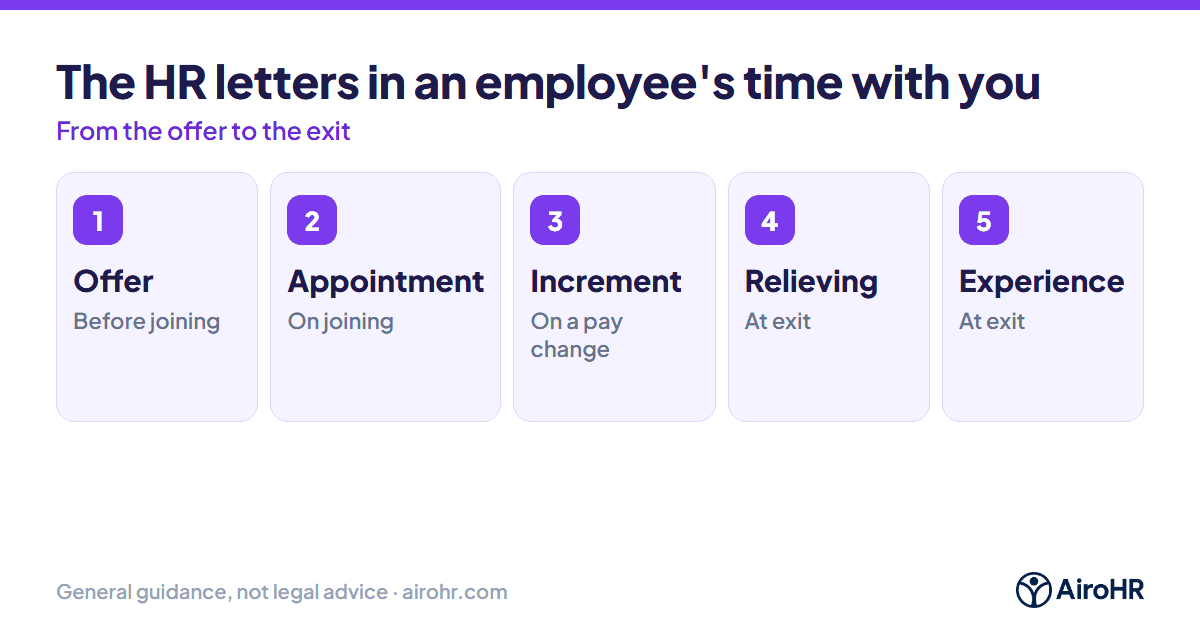
The HR letters in an employee's time with a company: offer letter before joining, appointment letter on joining, increment letter on a pay change, relieving and experience letters at exit.
The five HR letters, from offer to exit.

Key facts (as of 13 November 2026)

  • Appointment letters are mandatory for all workers under the four Labour Codes, in force from 21 November 2025 (PIB).
  • Wages due at exit must be paid within two working days: section 17(2), Code on Wages, 2019 (Ministry of Labour and Employment).
  • We found no government format for offer, relieving or experience letters; employers use their own wording.

Updated 13 November 2026.

Which HR letters does an employee need?

At least four: an offer letter before joining, an appointment letter on joining, and a relieving letter and an experience letter at exit. Many employers also issue increment, confirmation and warning letters. Under the Labour Codes, the appointment letter is the one every worker must get.

LetterWhenWhat it does
Offer letterBefore joiningProposes the role, pay and joining date.
Appointment letterOn joiningConfirms designation, wages, social security and terms of service.
Increment letterOn a pay changeRecords the new salary and the date it applies from.
Relieving letterAt exitConfirms the resignation was accepted and the employee is released.
Experience letterAt exitConfirms the dates of service and the roles held.

Is an appointment letter mandatory in India?

Yes. Since the four Labour Codes came into force on 21 November 2025, every worker must be given an appointment letter, with details such as designation, wages and social security. Staff who joined earlier and never got one should be issued one now. See the Labour Codes payroll checklist.

What is the difference between an offer letter and an appointment letter?

An offer letter is sent before joining and proposes the job, salary and joining date; the candidate accepts it. An appointment letter is issued when the person joins and confirms the terms of employment: designation, wages, working hours, leave, PF and ESI, probation and notice period.

Offer letter format

[Company letterhead] Date: [date] [Candidate name] [Address] Subject: Offer of employment Dear [Candidate name], We are pleased to offer you the position of [designation] in our [department] team at [work location]. Your total annual cost to company will be ₹[amount], as set out in the attached salary breakup. Your expected date of joining is [date]. This offer is subject to satisfactory documents and verification. Your detailed terms of employment will be given in your appointment letter on joining. Please sign and return a copy of this letter by [date] to confirm your acceptance. For [Company name] [Name] [Designation] Accepted: ____________ (Candidate signature and date)

Appointment letter format

[Company letterhead] Date: [date] [Employee name] Employee code: [code] Subject: Letter of appointment Dear [Employee name], We are pleased to appoint you as [designation] in [department], at [work location], with effect from [date of joining]. 1. Wages: your monthly gross wages are ₹[amount], as per the salary breakup attached. 2. Social security: you will be covered under PF and ESI as applicable, and statutory deductions will be made from your wages. 3. Working hours and leave: as per company policy and the law that applies to your workplace. 4. Probation: [period], after which your service will be confirmed in writing. 5. Notice period: [period] on either side after confirmation. Please sign a copy of this letter as your acceptance of these terms. For [Company name] [Name] [Designation] Accepted: ____________ (Employee signature and date)

What is the difference between a relieving letter and an experience letter?

A relieving letter confirms that the resignation was accepted and the employee has been released from duty on a given date. An experience letter confirms how long the person worked with you and in what roles. Many employers combine both in one letter, issued on or after the last working day.

Do not hold back final wages while the letters are prepared. Wages due at exit must be paid within two working days. See the full and final settlement guide.

Relieving letter format

[Company letterhead] Date: [date] [Employee name] Employee code: [code] Subject: Relieving letter Dear [Employee name], This is to confirm that your resignation dated [date] has been accepted, and you are relieved from your duties as [designation] with effect from the close of business on [last working day]. Your full and final settlement [has been paid / will be paid on (date)]. We thank you for your contribution and wish you well. For [Company name] [Name] [Designation]

Experience letter format

[Company letterhead] Date: [date] TO WHOMSOEVER IT MAY CONCERN This is to certify that [Employee name] (employee code [code]) worked with [Company name] from [date of joining] to [last working day]. During this period, [he / she / they] held the position of [designation] in [department], and [was / were] responsible for [two or three main duties]. We wish [him / her / them] success in the future. For [Company name] [Name] [Designation]

How should HR issue and keep these letters?

  1. Use your letterhead and one authorised signatory.
  2. Fill every bracket; never leave a placeholder in a sent letter.
  3. Attach the salary breakup to offer and appointment letters.
  4. Get the employee's signature on offer and appointment letters.
  5. Keep a signed copy on the employee's record.

HR letters in AiroHR

AiroHR has ready templates for offer, appointment, increment, experience and relieving letters, which you can edit and add to. Letters go out on your letterhead by email or WhatsApp, and employees sign in the portal or on a one-time code link, with a signing certificate saved for each link signature.

Letters & e-Sign Exit & F&F

Where to confirm

Commentary this guide was written from

Work it out, then stay up to date

Use the free salary slip generator, or get each month's PF, ESI, PT and TDS dates by email with free compliance alerts.

Related guides

The letters on this page are sample wording, not legal formats. Adapt them to your policies and the state rules that apply, and take advice on terms such as notice and probation. Last reviewed: 13 November 2026.

FAQ

HR letter questions, answered

Is an appointment letter mandatory in India?

Yes. Under the four Labour Codes, in force from 21 November 2025, every worker must get an appointment letter with details such as designation, wages and social security, including existing staff who never received one.

What is the difference between an offer letter and an appointment letter?

An offer letter is sent before joining and proposes the job, salary and joining date. An appointment letter is issued on joining and confirms the terms of employment.

What is the difference between a relieving letter and an experience letter?

A relieving letter confirms the resignation was accepted and the employee was released on a given date. An experience letter confirms the period of service and the roles held. Many employers combine the two.

When should a relieving letter be issued?

On or after the last working day, once the resignation has been accepted. Final wages are due within two working days of exit whether or not the letter is ready.

What should an experience letter contain?

The employee's name and code, the dates of joining and leaving, the designations held, a short line on the main duties, and the signature of an authorised person on the company letterhead.

Is there a government format for offer or experience letters?

We found no government format for offer, relieving or experience letters for private employers. Use clear wording on your letterhead, signed by an authorised person.

Issue letters in minutes, signed online

Book a demo and we will show offer and appointment letters going out on your letterhead.

Book a demo

More guides: all payroll & compliance guides · free compliance alerts by email