
Key points
- Wages due must be paid within two working days when an employee resigns, is removed, dismissed or retrenched, or the establishment closes.
- The most common reading is that the two days start from the last working day.
- Gratuity has its own 30-day period, and PF is claimed by the employee from EPFO.
- You cannot hold back the whole settlement until a laptop comes back or clearance is signed.
The two-day rule
Section 17(2) of the Code on Wages, 2019 says that where an employee has been removed or dismissed from service, retrenched, has resigned, or became unemployed because the establishment closed, the wages payable must be paid within two working days. The Code took effect on 21 November 2025.
The older law covered exits started by the employer. The Code also covers resignation, which is how most people leave, so this is a large change for any company that takes weeks to settle.
What goes into the settlement, and when
| Item | When | Notes |
|---|---|---|
| Salary to the last working day | Two working days | Clearly within the rule. |
| Leave encashment | Plan for two working days | Whether it counts as wages is disputed. Paying it early is the safer course. See the leave encashment guide. |
| Contractual bonus already due | Plan for two working days | A bonus that is part of the employee's pay is not excluded. |
| Statutory bonus | Check | Sources differ. See the statutory bonus guide. |
| Reimbursements | Promptly | Sources differ on whether these fall within the two days. |
| Gratuity | 30 days | Has its own period. See the gratuity guide. |
| Provident Fund | Employee's claim | The employee claims transfer or withdrawal from EPFO. |
What you can deduct
Section 18 of the Code allows only listed deductions from wages. As reported, these include fines, absence from duty, damage to or loss of goods entrusted to the employee, housing and amenities, advances and loans, income tax and social security contributions. Total deductions in a wage period cannot be more than 50% of wages.
- Loans and advances: allowed, within the 50% limit.
- Unreturned company property: a deduction for loss of goods entrusted to the employee is allowed, subject to its conditions.
- TDS: tax on the amounts paid at exit still applies. See the TDS on salary guide.
Can you hold the settlement until clearance?
Not all of it. Commentators agree that the Code does not make payment of wages depend on exit clearance or a no-dues form. If a laptop has not come back, work out its value, deduct what you are allowed to, and pay the balance on time.
Worked example
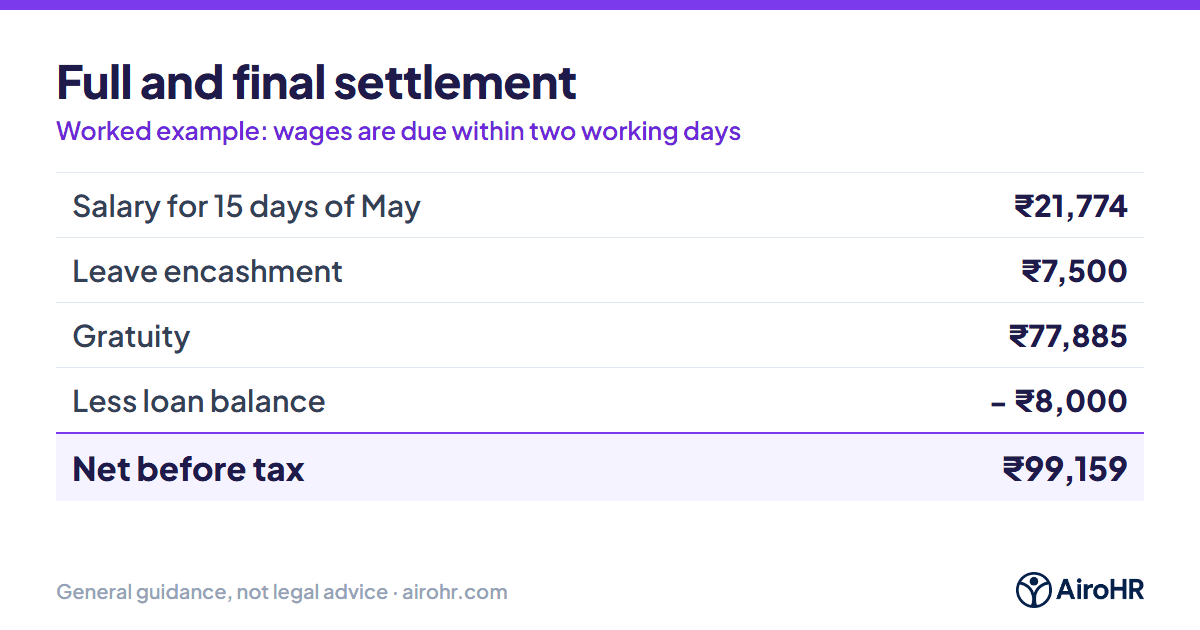
An employee on ₹45,000 a month, with basic and DA of ₹22,500, leaves on 15 May after 6 years. They have 10 days of leave to encash and a loan balance of ₹8,000. Your policy pays leave on basic and DA over 30 days. This example uses basic and DA for gratuity to keep it simple. Under the Code the wage figure may be higher.
| Item | Working | Amount |
|---|---|---|
| Salary for 15 days of May | ₹45,000 × 15 ÷ 31 | ₹21,774 |
| Leave encashment | ₹22,500 ÷ 30 × 10 | ₹7,500 |
| Gratuity | ₹22,500 × 15 ÷ 26 × 6 | ₹77,885 |
| Less loan balance | − ₹8,000 | |
| Net before tax | ₹99,159 |
PF, ESI and TDS still apply as usual to the final salary.
F&F checklist
- Confirm the last working day as soon as a resignation is accepted.
- Lock attendance up to that day.
- Add up salary, leave, bonus and claims.
- List loans, advances and assets still out.
- Check deductions against section 18 and the 50% limit.
- Pay wages within two working days of the last working day.
- Pay gratuity within 30 days.
- Issue the settlement statement and relieving letter.
F&F in AiroHR
The exit screen works out unpaid salary, leave encashment, gratuity, notice recovery and the loans and advances still owed. HR can change any line, and items not returned must be cleared or waived with a reason before the settlement is marked paid. It does not count the two working days for you, so plan the date yourself.
Exit & F&F LettersWhere to confirm
- Ministry of Labour and Employment — the Code on Wages and its rules.
- EPFO — PF withdrawal and transfer after exit.
Commentary this guide was written from
- LiveLaw: Two Working Days, Code on Wages and final settlement (3 October 2026)
- Patron Accounting: the two-day F&F rule
- Nexdigm: 2-day settlement under the Labour Codes
Work it out, then stay up to date
Use the free gratuity calculator, or get each month's PF, ESI, PT and TDS dates by email with free compliance alerts.
Related guides
This guide is general guidance, not legal advice. It is based on published commentary, because we could not read the Code directly, and state rules may differ. Confirm before you act. Last reviewed: 30 October 2026.