
Key points
- Bonus now sits in Chapter IV of the Code on Wages, 2019, in force from 21 November 2025.
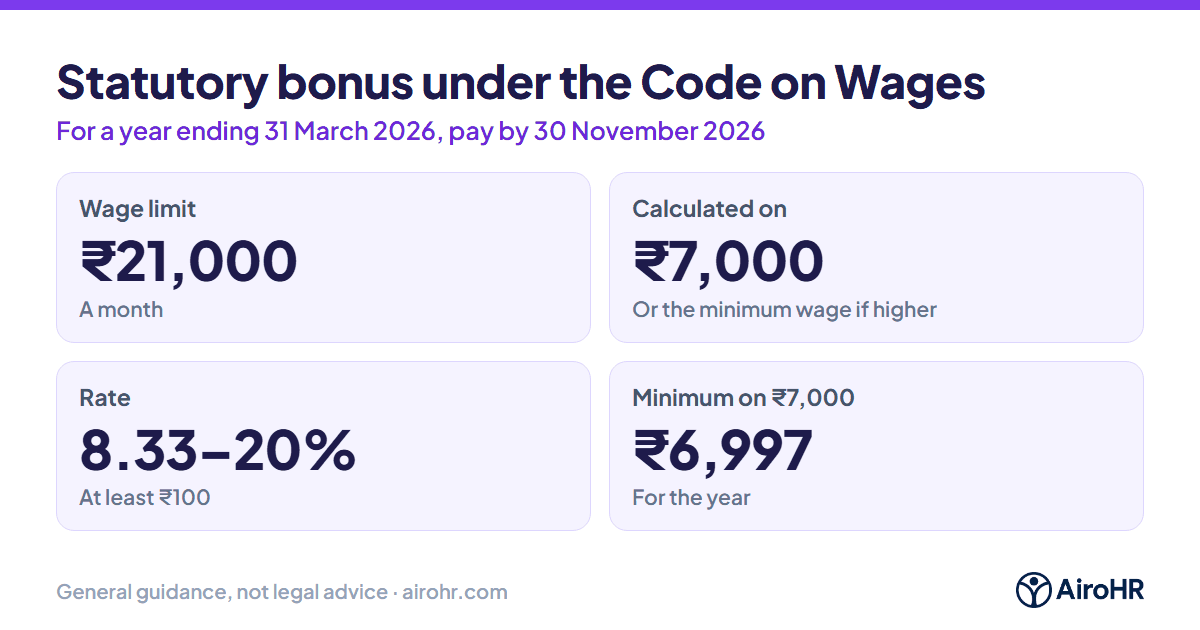
- Two Central notifications of 25 August 2026 set a ₹21,000 monthly wage limit for eligibility and a ₹7,000 figure for calculation, or the Central minimum wage if that is higher. States are expected to issue their own.
- The minimum is 8.33% of wages or ₹100, whichever is higher. The maximum is 20%.
- Pay within eight months of the end of the accounting year. For a year ending 31 March 2026, that is 30 November 2026.
What changed
The Payment of Bonus Act, 1965 was repealed when the Code on Wages, 2019 took effect on 21 November 2025. Bonus is now covered by sections 26 to 41 of the Code. The basic idea has not changed: an eligible employee gets at least a minimum bonus each year, and can get more if the establishment has an allocable surplus.
For several months the wage limits under the Code were unclear. Two Central Government notifications dated 25 August 2026 set them, with effect from 21 November 2025.
| Notification | Purpose | Figure |
|---|---|---|
| S.O. 4711(E) | Who is eligible (section 26(1)) | Employees drawing wages of up to ₹21,000 a month |
| S.O. 4710(E) | How bonus is calculated (section 26(2)) | Where wages are above ₹7,000 a month, calculate as if they were ₹7,000 or the minimum wage fixed by the Central Government, whichever is higher |
Which wages count
Khaitan & Co says the main change is that bonus now runs on the Code's revised definition of wages, not the old Act's salary or wage. Those are basic pay, dearness allowance and retaining allowance, plus allowances that are not on the excluded list. If the excluded items are more than half of total pay, the excess is added back. See the Labour Codes checklist for how this works.
This can change who qualifies. Someone with a basic of ₹19,000 and a large HRA may be under ₹21,000 on basic alone but over it once the 50% rule is applied. Check your wage components before you make your list.
Who gets bonus
- The establishment: one where 20 or more persons are employed, or were employed on any day of the accounting year. The Code does not bring in every factory the way the old Act did, so a factory with fewer than 20 people may now fall outside this chapter.
- The employee: wages of up to ₹21,000 a month, and at least 30 days of work in the accounting year.
None of the sources we read says what happens when wages cross ₹21,000 during the year. One careful reading is to count only the months within the limit, but take advice if this affects many staff.
Some bodies are outside the chapter, including Central and State Government establishments, local authorities, LIC, the RBI and certain non-profit bodies. Check section 41 if you are close to one of these groups.
Who loses the right to bonus
An employee dismissed from service for one of these reasons is disqualified:
- fraud;
- riotous or violent behaviour on the premises;
- theft, misappropriation or sabotage of the establishment's property;
- conviction for sexual harassment, which is a new ground.
How much to pay
| Item | Rule |
|---|---|
| Minimum bonus | 8.33% of wages earned in the accounting year, or ₹100, whichever is higher. Payable even without an allocable surplus. |
| Maximum bonus | 20% of those wages. |
| Allocable surplus | 67% of the available surplus, or 60% for a banking company. |
| Part-year work | The minimum is reduced in proportion where it is more than 8.33% of the wages for the days actually worked. |
Worked example
An employee earns wages of ₹18,000 a month, worked the whole year, and is within the ₹21,000 limit. Wages are above ₹7,000, so bonus is calculated on the notional figure.
| Calculation base | Working | Minimum bonus for the year |
|---|---|---|
| ₹7,000 a month | ₹7,000 × 12 × 8.33% | ₹6,997 |
| Minimum wage of ₹15,000 a month (illustration only) | ₹15,000 × 12 × 8.33% | ₹14,994 |
The second row shows why the "whichever is higher" wording matters. Where the applicable minimum wage is above ₹7,000, the bonus can be more than double. The ₹15,000 is an illustration, not a real rate. Look up the rate for your employees.
When and how to pay
- Pay within eight months of the close of the accounting year. The year ended 31 March 2026 gives a date of 30 November 2026.
- Pay by crediting the employee's bank account. The old Act required payment in cash.
- The Government can extend the time on application, but not beyond two years in total.
- If a dispute is pending, payment is due within one month of the award or settlement taking effect. Where the dispute is only about a higher rate, the 8.33% minimum is still due on time.
Bonus checklist
- Confirm you have 20 or more persons in the accounting year.
- Check your wage components against the Code's definition of wages.
- List employees with wages of up to ₹21,000 and at least 30 days of work.
- Find the minimum wage that applies to each group of staff. Central rates are fixed by the day, and a summary of the Central Rules says to multiply by 26 for a monthly figure.
- Calculate on the higher of ₹7,000 and that minimum wage.
- Work out your allocable surplus to see if more than 8.33% is due.
- Credit bank accounts before the deadline and keep the records.
The old Act's Forms C and D are still widely used as records. None of the sources we read confirms whether they continue or have been replaced, so check the rules that apply to you.
Bonus in AiroHR
AiroHR's Statutory Bonus Register works from locked payroll. It uses wages under the Code, tests each month against ₹21,000 and checks 30 days of work, then shows who qualifies and why others do not. You enter your minimum wage and bonus rate for the year, and it tracks who has been paid and produces reports in the old Form C and Form D layouts. It holds one minimum wage per company and does not work out allocable surplus. It only sees months locked in AiroHR, so a year paid elsewhere has to be worked out from those records.
Payroll software Labour Codes checklistWhere to confirm
- Ministry of Labour and Employment — the Code on Wages, rules and notifications.
- e-Gazette of India — search for S.O. 4710(E) and S.O. 4711(E), both dated 25 August 2026.
Commentary this guide was written from
- Gazette copy of S.O. 4710(E), on TaxHeal
- Khaitan & Co: Ergo on bonus payout, 4 September 2026
- Anhad Law: the Code on Wages (Central) Rules, 2026
- Lakshmikumaran & Sridharan: employment law update, 31 August 2026
- AZB & Partners: note on the bonus notifications
- Taxmann: bonus under the Code on Wages, 2019
- Indian Pay Calculator: private job statutory bonus
Work it out, then stay up to date
Use the free salary slip generator, or get each month's PF, ESI, PT and TDS dates by email with free compliance alerts.
Related guides
This guide is general guidance, not legal advice. We read S.O. 4710(E) in a copy of the Gazette. The rest comes from published commentary, so confirm the figures before you act. Last reviewed: 30 October 2026.