
Key points
- Leave encashed during service is fully taxable as salary.
- At retirement or resignation, private-sector staff get an exemption, capped at ₹25 lakh across their working life.
- Government employees' leave encashment at retirement is fully exempt.
- Commentary on the OSH Code describes a 30-day carry-forward limit, with the excess paid out.
When leave can be encashed
Most encashment happens in one of two ways: during employment, where a company's policy allows it, or at exit, when the balance is paid as part of the full and final settlement. The tax treatment is very different.
What the Labour Codes changed
The Occupational Safety, Health and Working Conditions Code, 2020 deals with annual leave. As commentators describe section 32:
- A worker qualifies after 180 days of work in a calendar year, down from 240 under the Factories Act.
- Leave builds at one day for every 20 days worked.
- Unused leave carries forward up to 30 days.
- Leave above that limit is paid out instead of lapsing. Commentators also describe encashment on demand at the end of the year.
- Leave that was applied for and refused is treated differently and is not lost to the limit.
Tax on leave encashment
| When paid | Who | Tax |
|---|---|---|
| During service | Everyone | Fully taxable as salary. Relief may be available for arrears. |
| At retirement or resignation | Central and State Government | Fully exempt |
| At retirement or resignation | Private sector | Exempt up to the lowest of four limits, and the rest is taxable |
| On death | Paid to the legal heir | Fully exempt |
The four limits for private-sector staff
The exempt amount is the lowest of:
- ₹25 lakh, the limit notified by the Government;
- the leave encashment actually received;
- average salary of the last 10 months × 10;
- average salary per day × unused leave, counting no more than 30 days of leave for each completed year of service.
Salary here means basic, DA and commission paid as a fixed percentage of turnover. The ₹25 lakh is a lifetime limit, so any amount exempted earlier reduces it.
Worked example
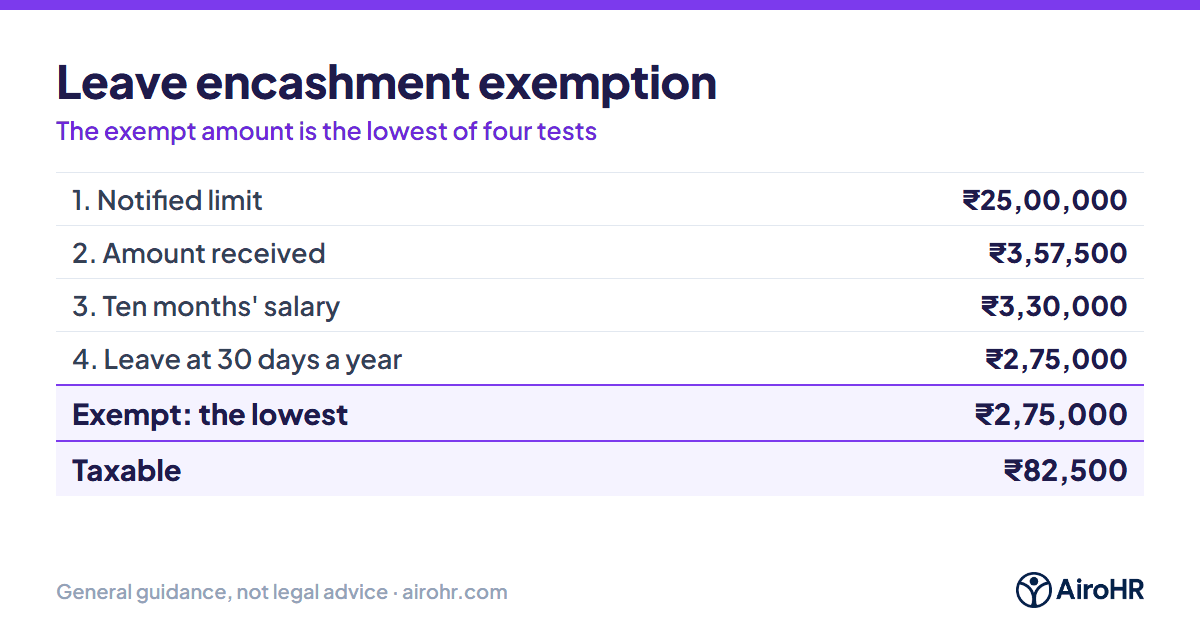
A private-sector employee resigns after 15 years. They earned 35 days of leave a year and used 200 days, leaving 325 days. Average salary is ₹33,000 a month, or ₹1,100 a day, and their employer pays all 325 days.
| Test | Working | Amount |
|---|---|---|
| 1. Notified limit | ₹25,00,000 | |
| 2. Amount received | 325 × ₹1,100 | ₹3,57,500 |
| 3. Ten months' salary | ₹33,000 × 10 | ₹3,30,000 |
| 4. Leave at 30 days a year | (30 × 15 − 200) × ₹1,100 | ₹2,75,000 |
| Exempt: the lowest | ₹2,75,000 | |
| Taxable | ₹3,57,500 − ₹2,75,000 | ₹82,500 |
How to work out the amount
The Tax Act sets what is exempt, but your policy sets what is paid. A typical calculation is:
Leave encashment = daily rate × unused leave days
Policies differ on the daily rate. Some divide by 26, some by 30 and some by the days in the month, and some use basic and DA while others use gross pay. Write your method into your leave policy and use it every time.
Leave encashment in AiroHR
Each leave type can be set to carry forward, lapse or be encashable, with a maximum number of days. At exit, the settlement follows each leave type's setting: encashable and carry-forward days are paid up to that maximum at basic pay per day for the last month, days set to lapse are not paid, and HR can change the figure. The tax exemption above is not worked out for you.
Exit & F&F HR softwareWhere to confirm
- Ministry of Labour and Employment — the OSH Code, 2020 and its rules.
- Income Tax Department — exemptions under the Income-tax Act, 2025.
Commentary this guide was written from
- ClearTax: leave encashment tax
- Tax Clue: section 32, OSH Code
- EZHRM: leave encashment rules and the OSH Code
Work it out, then stay up to date
Use the free gratuity calculator, or get each month's PF, ESI, PT and TDS dates by email with free compliance alerts.
Related guides
This guide is general guidance, not legal or tax advice. It is based on published commentary, because we could not read the Code or the new Act directly. Confirm before you act. Last reviewed: 30 October 2026.