
Key points
- Gratuity is now under section 53 of the Code on Social Security, 2020, in force from 21 November 2025.
- Regular staff qualify after five years of continuous service. Fixed-term staff qualify after one year.
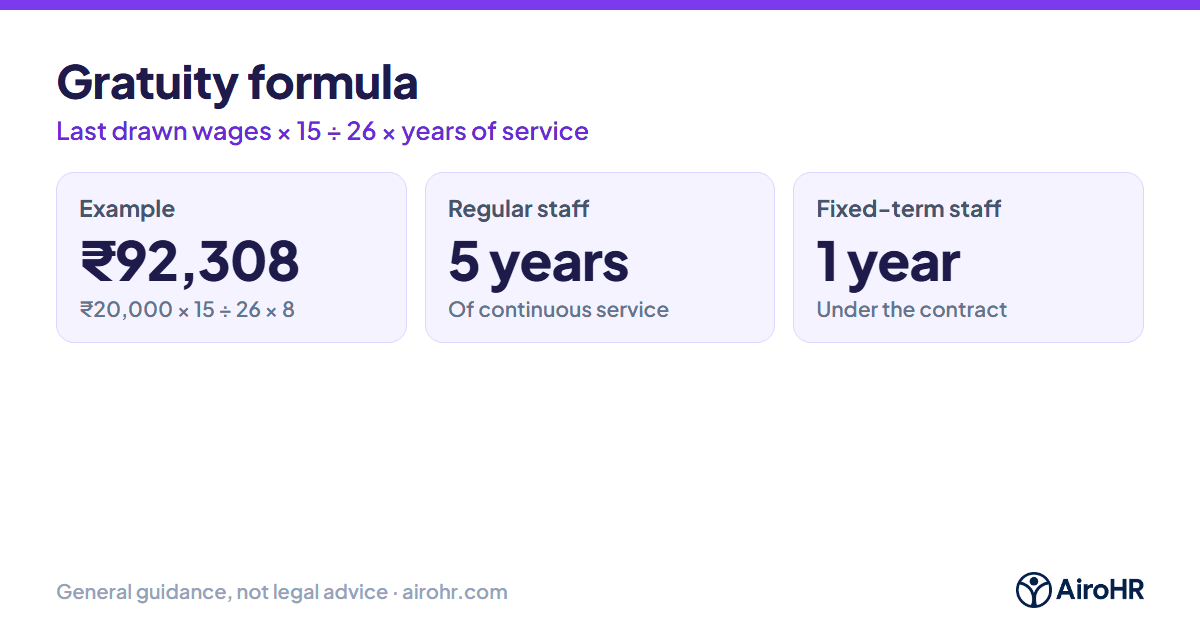
- Formula: last drawn wages × 15 ÷ 26 × years of service, counting a part-year of more than six months as a full year.
- The Ministry's FAQs say gratuity uses the Code's definition of wages, which can be higher than basic pay.
Who qualifies
| Employee | Service needed |
|---|---|
| Regular employee | Five years of continuous service |
| Fixed-term employee | One year under the contract |
| Contract labour | Five years, paid by the contractor as the employer |
| Death or disablement | The five-year condition does not apply |
A fixed-term employee who leaves before completing one year is generally not eligible. Whether back-to-back contracts add up to one year is still an open question.
The formula
Gratuity is 15 days' wages for each completed year of service, and any part of a year above six months counts as a full year. A month is treated as 26 working days, so:
Gratuity = last drawn monthly wages × 15 ÷ 26 × years of service
Which wages count
This is the biggest change. Wages under the Codes include basic pay, dearness allowance and retaining allowance. Items such as HRA, conveyance and overtime are left out, but if the left-out items are more than half of total pay, the excess is added back. See the Labour Codes checklist for how the 50% test works.
The Ministry's FAQs of 16 March 2026 are reported to say that gratuity on the revised definition applies from 21 November 2025, and that it is paid on the wages last drawn. Commentators read this to mean the new wage figure applies to the whole period of service for anyone leaving after that date. The FAQs are guidance and not a rule, so take advice if the amounts are large.
Worked examples
Regular employee, 7 years 8 months
Total pay is ₹40,000 a month: basic ₹18,000 and other items ₹22,000. The other items are ₹2,000 above half of total pay, so wages for gratuity become ₹20,000. The 8 months are more than six months, so service counts as 8 years.
| Base used | Working | Gratuity |
|---|---|---|
| Wages under the Code: ₹20,000 | ₹20,000 × 15 ÷ 26 × 8 | ₹92,308 |
| Basic pay only: ₹18,000 | ₹18,000 × 15 ÷ 26 × 8 | ₹83,077 |
The gap is why the wage base needs checking before you settle.
Fixed-term employee, 1 year 7 months
Wages are ₹26,000 a month. Sources describe fixed-term gratuity as pro rata, so one way to work it out is by whole months: 19 months is 19 ÷ 12 of a year. That gives ₹26,000 × 15 ÷ 26 × 19 ÷ 12 = ₹23,750. If the six-month rounding were applied instead, service would count as 2 years and gratuity would be ₹30,000. Sources do not settle which applies, so check your contract and take advice.
The ceiling
The limit under the old law was ₹20 lakh, set in March 2018. The Code lets the Central Government notify the limit, and the most recent commentary we read found no new notification, so ₹20 lakh is the working ceiling. Confirm this if you have employees near the limit.
Paying gratuity
- Pay within 30 days of it becoming payable. Sources cite this period, and late payment attracts interest.
- Pay it separately from the wages due at exit. See the full and final settlement guide for how the two deadlines fit together.
- Gratuity has been tax-exempt up to ₹20 lakh for private-sector employees. Check the current treatment under the Income-tax Act, 2025.
Gratuity in AiroHR
The exit settlement works out gratuity using the five-year rule, or the one-year rule for staff marked as Fixed-Term Employees, with the ₹20 lakh limit. The Gratuity Register lists who has reached that service. AiroHR uses basic pay for this figure, so compare it with the wage under the Code. HR can change the amount before approving the settlement.
Exit & F&F Payroll softwareWhere to confirm
- Ministry of Labour and Employment — the Code on Social Security, its rules and the FAQs of 16 March 2026.
- Income Tax Department — tax treatment under the Income-tax Act, 2025.
Commentary this guide was written from
- Kredily: new Labour Codes and gratuity (updated 15 August 2026)
- SCC Online: Ministry FAQs on the four Labour Codes
- King Stubb & Kasiva: Labour Codes FAQs 2026
Work it out, then stay up to date
Use the free gratuity calculator, or get each month's PF, ESI, PT and TDS dates by email with free compliance alerts.
Related guides
This guide is general guidance, not legal or tax advice. It is based on published commentary, because we could not read the Ministry's FAQs or the Code directly. Confirm before you act. Last reviewed: 30 October 2026.