
Key points
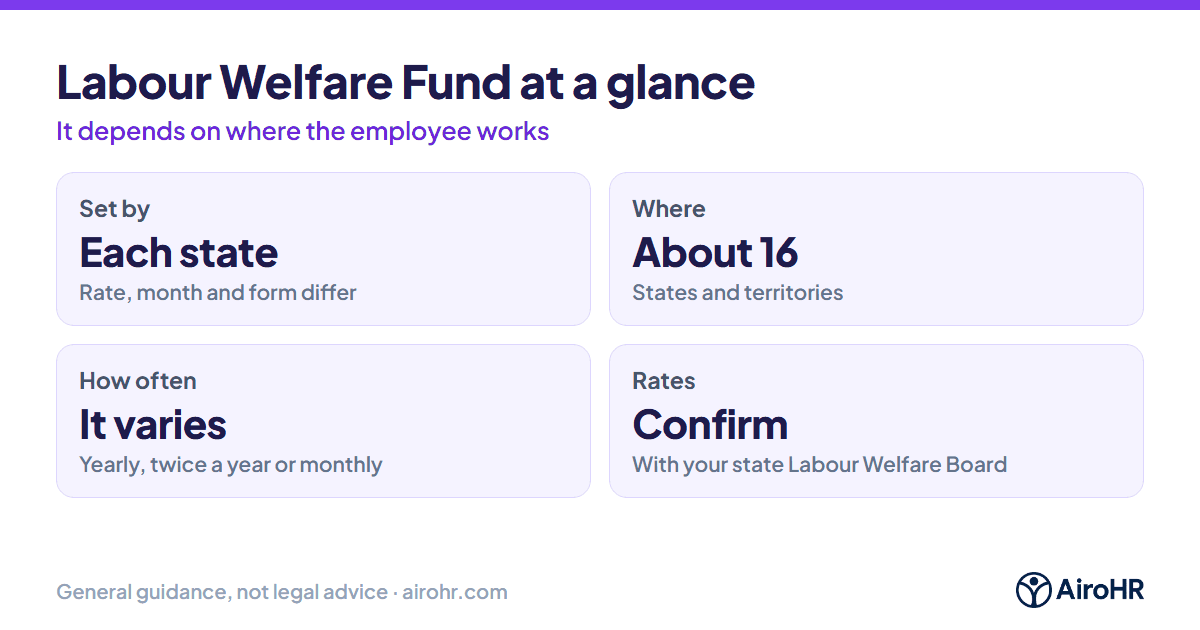
- LWF is a state contribution, so the rate, month and form depend on where the employee works.
- Most lists show about 16 states and territories with an LWF. Several, including Uttar Pradesh and Bihar, have none.
- Some states collect it once a year, some twice, and some every month.
- Published rate tables often disagree, so always confirm with your state Labour Welfare Board.
What LWF is
A Labour Welfare Fund is a state fund used for the welfare of workers and their families. The employee pays a small amount, the employer pays a larger one, and some states add their own share. The employer deducts the employee's part from salary and sends both parts to the state's Labour Welfare Board.
LWF is set by state law, not central law. A company with staff in three states may have three different rules to follow.
Rates in the larger states
We compared six published rate tables. No state matched on every point, so this table shows only states where most of them agree. Treat it as a starting point.
| State | Employee | Employer | How often | Deduct in | Pay by |
|---|---|---|---|---|---|
| Karnataka | ₹50 | ₹100 | Yearly | December | Lists show 31 December or 15 January |
| Maharashtra | ₹25 | ₹75 | Half-yearly | June, December | 15 July, 15 January |
| Gujarat | ₹6 | ₹12 | Half-yearly | June, December | 15 July, 15 January |
| Andhra Pradesh | ₹30 | ₹70 | Yearly | December | Lists show 31 December or 31 January |
| West Bengal | ₹3 | ₹30 | Half-yearly | June, December | 15 July, 15 January |
Where two dates are shown, use the earlier one until your Board confirms otherwise.
Haryana works differently
Haryana sets the employee's share at 0.2% of wages, up to a cap, and the employer pays twice that. The cap is reported to change every January, and the figures in circulation differ, so check the current one with the Board.
States where the lists disagree too much
For Tamil Nadu, Kerala, Punjab, Delhi, Telangana, Madhya Pradesh, Goa, Odisha, Chandigarh and Chhattisgarh, the published tables differ on the amount, how often it is paid, or both. Kerala also has separate funds for different kinds of establishment. We have left these out instead of guessing. Ask the state's Board for the current notification.
How to set up LWF correctly
- List the states where your employees actually work.
- Find each state's Labour Welfare Board and read its latest notification.
- Note who is covered. Some states exclude certain staff or set a wage limit.
- Note the amounts, the deduction months, the payment date and the return form.
- Set this up in payroll by state, so each employee follows their own state.
- Deduct in the right month, pay the Board and keep the receipt.
LWF in AiroHR
You set the LWF rule for each state, and payroll deducts it in the right months. The LWF return shows each state's figures from locked payroll, lists anyone not deducted and why, and lets you record the due date and challan. AiroHR does not fix due dates for you, because published dates conflict.
Payroll software Labour Codes checklistWhere to confirm
- Maharashtra Labour Welfare Board — rates, returns and payments for Maharashtra.
- Shram Suvidha portal — a starting point for labour filings.
Commentary this guide was written from
- Patron Accounting: LWF rates and due dates
- SalaryBox: LWF rates in India
- Mynd Solution: Labour Welfare Fund
- EZHRM: LWF compliance in India 2026
- CalcGuru: LWF in Maharashtra
- CalcGuru: LWF in Haryana
Work it out, then stay up to date
Use the free salary slip generator, or get each month's PF, ESI, PT and TDS dates by email with free compliance alerts.
Related guides
This guide is general guidance, not legal advice. Rates come from published lists that disagree with each other and were not checked against state notifications. Confirm with your state Board. Last reviewed: 30 October 2026.