
Key points
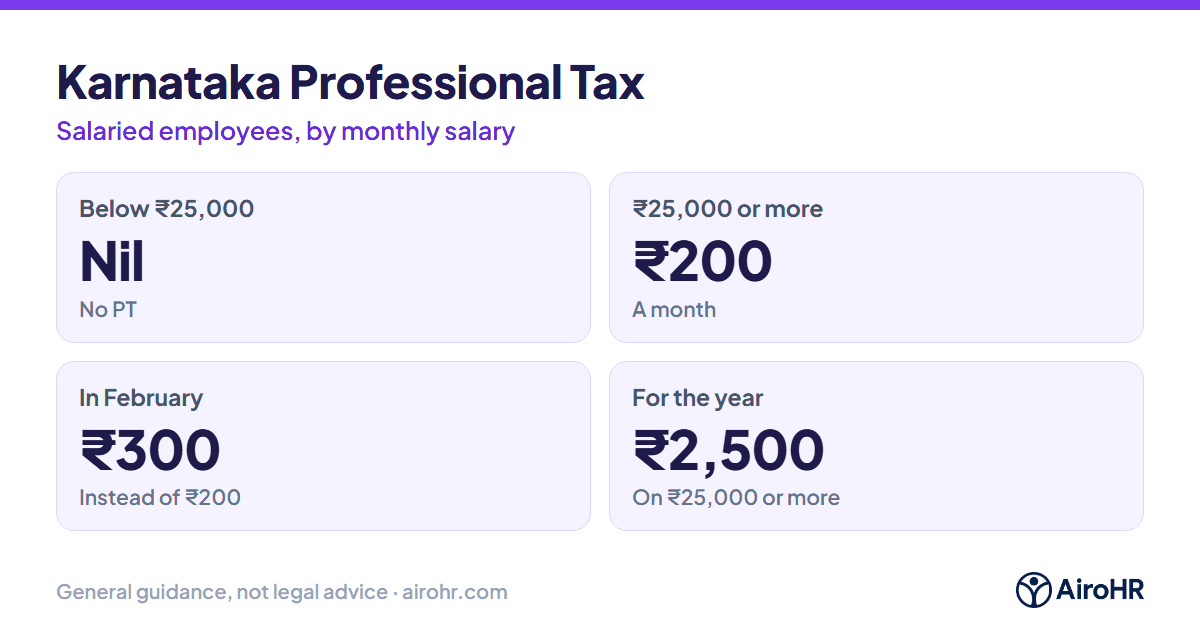
- Salary of ₹25,000 or more per month: PT is ₹200 per month, with ₹300 in February — ₹2,500 a year.
- Salary below ₹25,000 per month: nil.
- The employer deducts PT from salary and remits it to the state every month.
- Employers need registration to deduct employees' PT, and the business itself may also need to enrol and pay its own PT.
What is Professional Tax?
Professional Tax (PT) is a tax levied by state governments on professions, trades, callings and employment, under the power given by Article 276 of the Constitution. The Constitution caps the total PT any one person can pay in a year at ₹2,500. Each state sets its own slabs and procedures, so an employer with staff in several states has to apply a different PT rule in each state.
In Karnataka, PT is governed by the Karnataka Tax on Professions, Trades, Callings and Employments Act, 1976, administered by the Commercial Taxes Department.
Karnataka PT slab for salaried employees
| Monthly salary / wages | PT per month | February | Annual total |
|---|---|---|---|
| Below ₹25,000 | Nil | Nil | Nil |
| ₹25,000 and above | ₹200 | ₹300 | ₹2,500 |
Under the 2025 amendment, the February deduction was raised from ₹200 to ₹300, so that an employee liable for all twelve months pays 11 × ₹200 + ₹300 = ₹2,500, the constitutional maximum. Earlier, the annual total was ₹2,400.
How the slab is applied month by month
The slab is checked every month against that month's salary. So if an employee's salary is ₹26,000 in most months but falls to ₹23,000 in a month with loss-of-pay days, no PT is due for that month. Overtime paid in a month can take an employee over ₹25,000 for that month. Arrears and bonus work differently: under the Karnataka Act, arrears are spread over the months they relate to, and bonus over the months (up to twelve) it covers, so a one-off arrears or bonus payment does not by itself make a single month liable.
Examples
| Employee | Monthly salary | PT (Mar–Jan) | PT (Feb) |
|---|---|---|---|
| Office assistant | ₹18,500 | Nil | Nil |
| Accountant | ₹25,000 | ₹200 | ₹300 |
| Manager | ₹60,000 | ₹200 | ₹300 |
Notice that ₹25,000 exactly is liable — the threshold is "₹25,000 or more", not "more than ₹25,000".
State-wise PT, applied automatically
AiroHR applies the Professional Tax slabs you set up for each state in CTC Setup to each employee in every payroll run, testing the slab on gross earnings including overtime — including the higher February deduction in Karnataka. See payroll software for Karnataka.
PF, ESI & PT software Request free trialEmployer responsibilities
Registration: PTRC and PTEC
Two different registrations are commonly talked about:
- Registration certificate (often called PTRC) — needed by an employer to deduct PT from employees' salaries and pay it to the government.
- Enrolment certificate (often called PTEC) — for the business, firm, company or professional to pay its own PT as a person carrying on a profession or trade.
A company with salaried staff in Karnataka will typically need both. Registration is done online on the Karnataka PT portal; keep the certificate numbers handy because they are needed for every payment.
Monthly deduction and payment
- Finalise the month's payroll so salaries, loss of pay and overtime are settled.
- Apply the slab to each Karnataka-based employee and deduct PT from salary.
- Pay the PT deducted to the state online through the Karnataka PT portal, and file the monthly statement under section 6-A, within 20 days of the end of the month — that is, by the 20th of the following month (for example, PT deducted from September salaries is due by 20 October).
- File the returns required under the Act and keep challans with your payroll records.
Late payment or non-deduction can attract interest and penalty under the Act, and the employer remains liable for tax it should have deducted.
Employees in other states
PT follows the state where the employee works, not where the company is headquartered. A Bengaluru company with a sales team in Maharashtra or Tamil Nadu must apply those states' slabs (and registrations) to those employees. Some states do not levy PT on salaries at all.
Common Professional Tax mistakes
- Forgetting the February change. Deducting ₹200 in February leaves each liable employee ₹100 short for the year.
- Using annual CTC instead of monthly salary. The slab is applied to the salary for the month, so an employee on ₹25,000 a month is liable, while one whose month drops below ₹25,000 because of loss of pay is not liable for that month.
- Applying Karnataka slabs to staff in other states, or the reverse.
- Deducting but paying late. Tax deducted from employees belongs to the state; holding it attracts interest and penalty.
- Missing new joiners and exits in the month's PT working, especially mid-month joiners whose first month's salary is prorated.
A simple control is to reconcile the PT deducted in the month's payroll register with the amount paid on the portal before closing the month.
Showing PT on the payslip
PT should appear as a separate deduction line on the employee's payslip each month, along with PF, ESI and TDS. Under the old tax regime, PT paid is deductible from salary income; under the new regime (the default) it is not, so keep the annual total visible in year-end statements for employees on the old regime. See our salary slip format guide for a sample layout, and the TDS on salary guide for how employers handle income tax.
PF, ESI, PT and TDS in one payroll run
Attendance-linked payroll with every statutory deduction built in, payslips on email and WhatsApp, and compliance reports ready for the government portals. From ₹49 per employee per month.
Payroll software See pricingWork it out, then stay up to date
Use the free salary slip generator, or get each month's PF, ESI, PT and TDS dates by email with free compliance alerts.
Related guides
This article is general guidance, not legal or tax advice. Slabs change by notification — verify on the Karnataka Commercial Taxes / PT portal. Last reviewed: 15 October 2026.